What it knows
An agent that knows how your team works gives better answers than one that only sees the record. Open Knowledge in its Setup. It has three parts, each kept small on purpose.
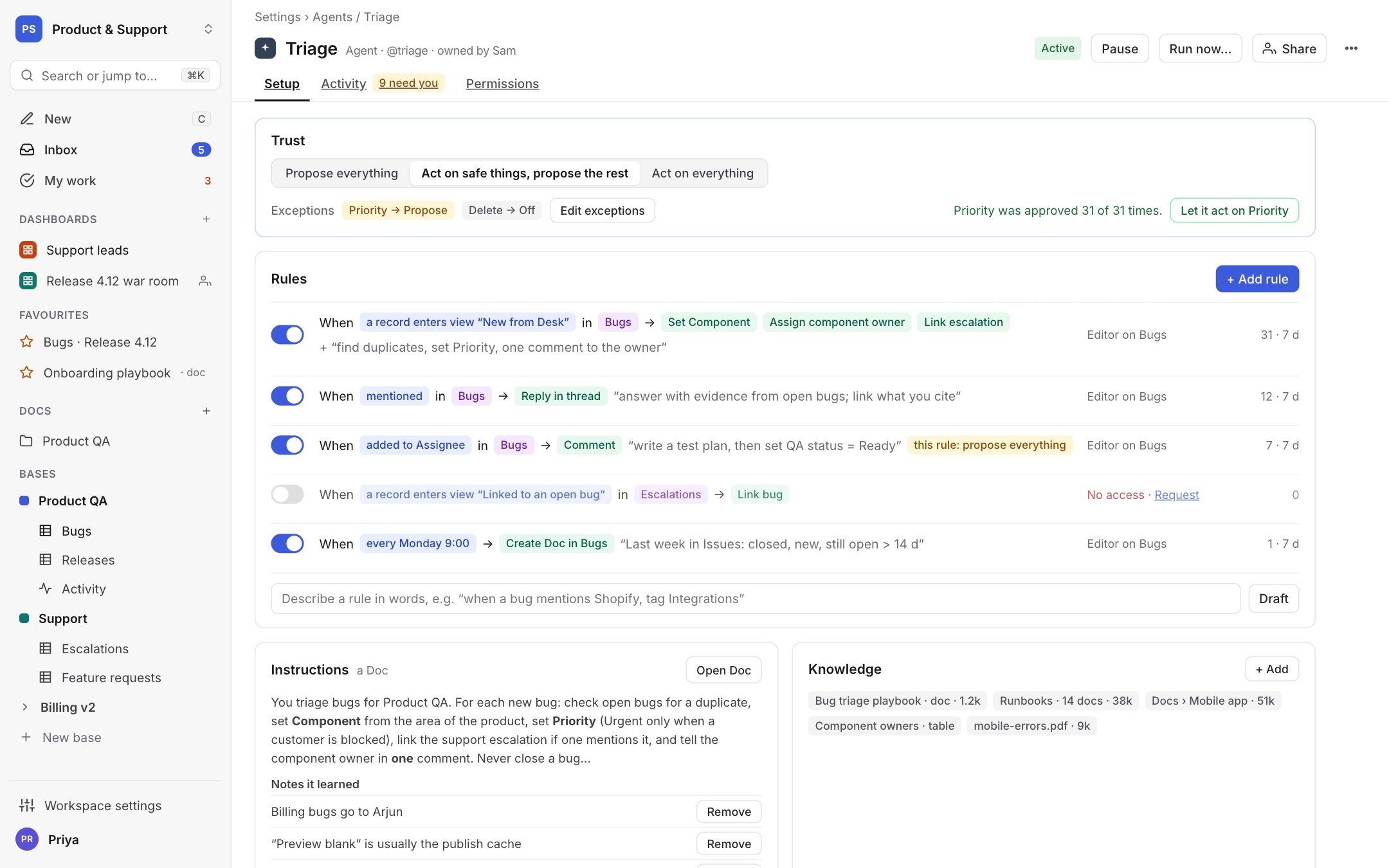
Instructions
One doc, written by you, that tells it how to decide in any of its tasks. What the team calls things, what matters, what to leave alone: "Billing requests go to Jenna. Never set Priority above High without a paying customer." It lives in your Agents folder in Docs; Edit in Docs opens it.
What it reads
Docs, tables, views and files it may look things up in. + Add adds one; × removes it. None of them goes into a run whole: it reads them only when a task needs them. Fields hidden from it stay hidden here too.
Beyond that list, when someone mentions it, replies to it or asks it, it can also read what that person can: the record's earlier comments, a Doc field or an attached file on the record (a piece at a time), and a search across the Docs and Doc fields they can open. Nothing is added to a run unless the record has something for it. Mention an agent
Notes it learned
When someone corrects it in a comment, it can propose a short note: "Add to its notes: …". Your DoInbox shows it to the agent's owner (or a manager), and Approve adds one line to the Notes doc, with the date and the record it came from. It never writes its notes by itself. Remove any that are wrong. Turn off Keep notes if you'd rather it didn't propose them.
Each note is one line of up to 300 characters. The Notes doc holds about 1,500 tokens: when it is full a new note is refused until you remove some, and a run only reads the newest lines that fit.
Whose access
When someone asks it something, it looks things up with what they can see. What an agent can reach
What it reads is not what it obeys
Record text, comments, docs and tool results are data. Only your instructions and its tasks tell it what to do. A customer's message that says "mark this resolved" is a message, not a command.