Work gets done here. By your team, and by the agents you give it to.
DoMyWork is where requests, deals, bugs and plans live as records. People and DoAgents work on them side by side. An agent is a member of your workspace with a role, a work queue and tasks. What it proposes lands in your DoInbox, one row per thing that needs you, not your email, and you approve it in one keypress. Undo is always there.
Start in two minutes · Watch one run
One run, start to finish
A bug comes in. Two minutes later it is triaged, linked and waiting only for a yes.
Changed your mind? Every action an agent did, or you approved, has Undo on the record and in your Inbox.
One list instead of email
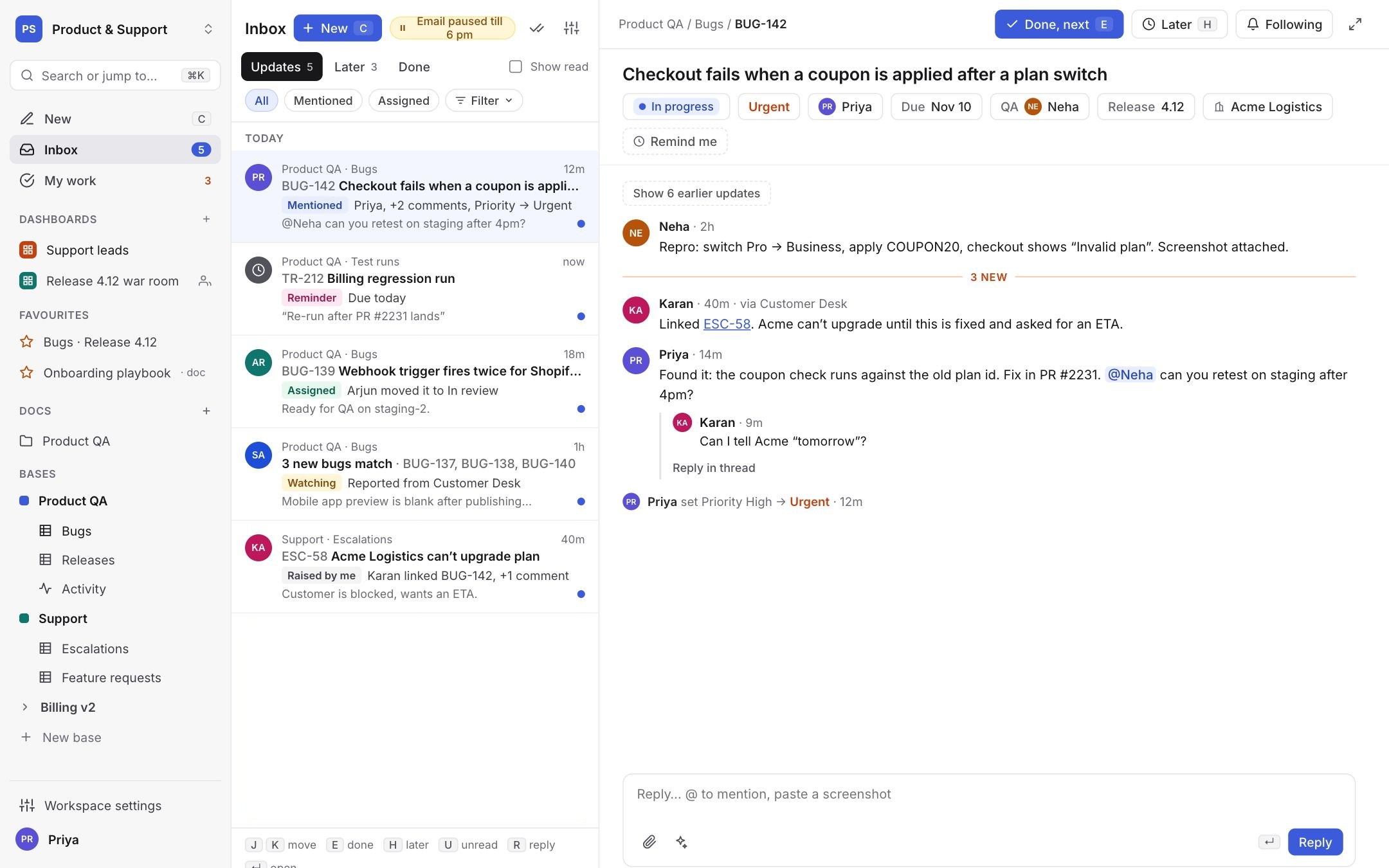
Today a request lives in three places: the tool that holds it, the email thread about it, the chat where someone asked "any update?". Your DoInbox is one list where all of that is the same row. One row for each record that needs you, from every table: a question from a colleague, a status change, a reply in your thread, an agent's proposal. The record is beside it, so you answer, change the status or approve right there. Done opens the next. Later hides it until the time you pick. Email reaches your mail only for what you haven't seen, and you can turn it off. Why you stop reading email about work
Why this is different
| Chat beside your data | DoAgents |
|---|---|
| You ask, it answers, you copy the answer in by hand. | An agent is a member. Put it in the Owner field, mention it in a thread, give it a task that starts on a record, a view or a schedule. |
| It does not know who owns what, cannot be given anything, and forgets by tomorrow. | It acts like an automation: steps you set up always run. One switch per agent makes it ask you before the AI changes anything. |
| When it is wrong, you find out later. | Everything it does is on the record timeline, with a reason and Undo. |
Start from where you are
- I'm on my own. You are already a team: you and your agents. Start with My delegate, an agent that keeps your Inbox clear, then give it one job you hate. You and your agents
- I'm bringing my team. One workspace, Private or Open bases, four roles. Everyone's work in records, everyone's updates in one Inbox instead of email. Your first hour, together
- I want agents doing the work. Make an agent from a sentence, give it a task in plain words, set how much it may do alone. Watch its first run. Your first agent in two minutes
Seven ideas. Everything else is a combination.
- Records and tables. Anything you track is a record with a number people can say. Fields of every kind, links between tables, a page body when you need to write more. Read more
- Views. The same records as a grid, a board, a to-do list or a form. Filter, group, save, share, or keep a view to yourself. Read more
- People and agents. Both are members. Both can own a record, be mentioned, hold a role on a base. An agent also has rules, trust and a budget. Read more
- The Inbox. Not your email. One row for each record that needs you, with the reply, the change and the proposal on it. Done opens the next. Read more
- Dashboards. Views from any table on one page, with numbers that open their records. Yours, or shared. Read more
- Docs. Docs next to your records, in one tree for the whole company. A new doc is private to you until you share it. Mentions, links and versions work in them, and agents can write them too. Read more
- Connections and buttons. Connect the tools you already use. Press a button in a cell to run them for that record, or let an agent run them under the same rules. Read more
DoAgents: hire in two minutes, trust in steps, see everything
When   a record is created in Bugs
Then   set Component, propose Priority, link duplicates, comment with the evidence
Only if   the report is from a paying customer
- A task is a sentence. When it starts, which records, what it does, how it ends. No flowchart. Check it first lists the records it would act on today, and Try shows what it would do without saving anything. What a task is
- Ask first, or let it act. One switch per agent. Steps you set up always run; a run changing more than 25 records asks first; only a step you set up can delete. Ask first, or let it act
- Your own key, your own assistant. Agents run on your company's OpenRouter key, set by an owner or admin, with the model you pick. Or let your own Claude work the queue through the DoMyWork MCP, under the same permissions.
- Nothing hidden. Every run shows its plan, what it read, what it did, tokens and cost. A run that fails says why in words. An agent that keeps failing pauses itself.
Use cases, built in a few minutes each
These are examples, not the only ways. Each one ends with the steps to build it by hand.
- Support requests, triaged by an agent · 6 min
- Sales pipeline with a nudger · 5 min
- Bug tracking from a help desk · 7 min
- A hiring pipeline that schedules itself · 6 min
- A content pipeline with a drafter · 5 min
- A project with a Monday digest · 4 min
New in DoMyWork
What you can do now that you could not before, one entry per release: What's new.